


Taper Roller Bearing Introduction
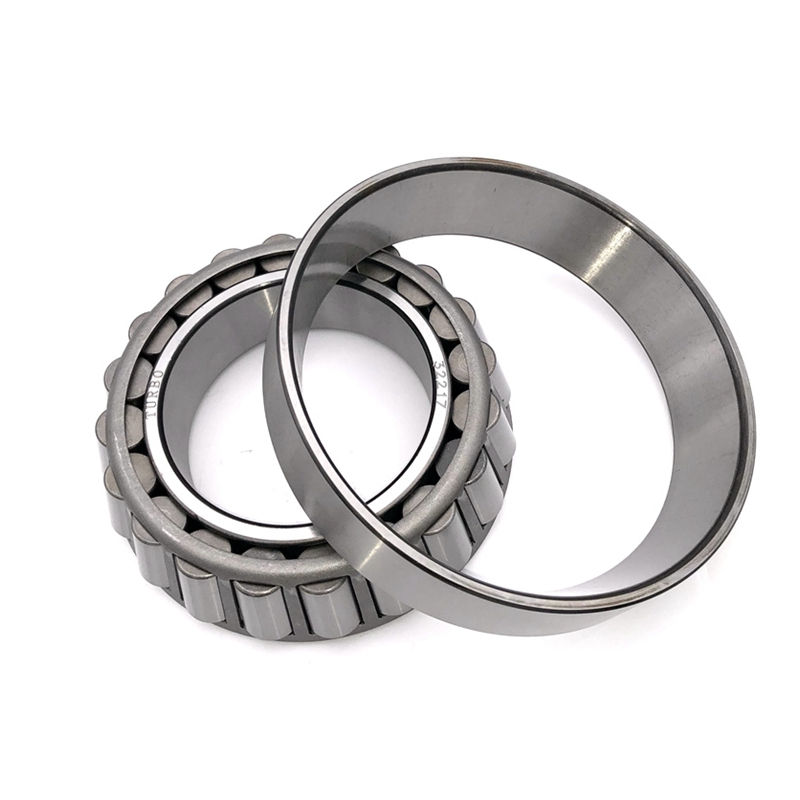
Taper Roller Bearing Introduction-Bearing Structure
Tapered roller bearing is a separate structure, and its inner ring, outer ring and rolling elements are all tapered.
If the generatrix of each tapered surface is extended, it will be crossed at a point on the bearing core line. Therefore, it ensures the best rolling state of the tapered roller bearing.
Tapered roller bearings can bear a large combined radial and axial load, and the bearing can bear axial loads.
The ability is determined by the contact angle of the outer ring, that is to say, the outer ring raceway angle. The greater the contact angle.
Tapered roller bearings will generate additional axial force under radial load.
Please pay attention that if bearing axial clearance is too small, bearing temperature will be high.
While if clearance is too big, bearing is easy to broken.
So during installation, users must pay attention to bearing clearance.
Taper Roller Bearing Introduction- Bearing Features
1. Load and Speed
Taper roller bearing can withstand combined load dominated by radial load. For instance, 30206J2/Q bearing.
Compared with contact ball bearings, its load carrying capacity, especially its bearing capacity is much larger.
But its max revolving speed is lower than the corresponding cylindrical roller bearing. Therefore, taper roller bearing is generally not used alone to bear radial load.
2. Axial Limit Ability and Sensitivity To Axis Skew
A single taper roller bearing has a strict axial limit ability in one direction.
When users use taper roller bearings in pairs, it can limit the axial relative displacement of the shaft on both sides, and has a larger supporting solution angle rigidity.
Moreover, taper roller bearing is very sensitive to axis skew, and it doesn’t allow the shaft to tilt relative to the housing hole.
Major Structural Variants
1) Structure with large cone angle
Its contact angle is 25 degree to 29 degree. This bearing can bear greater axial load.
2) The structure of double row double inner ring
This kind bearing can bear combined load, its radial load capacity is 170% of the corresponding single row bearing, the axial load bearing capacity of the bearing in any direction can reach 40% of the unused allowable radial load.
3) Structure without inner ring or outer ring
This type bearing has a compact structure and is used in occasions where the radial size is restricted.
4) The structure of four rows, double inner rings and three outer rings
This bearing can bear combined load dominated by extremely large radial load.
Its radial load capacity is three times that of single row bearings, moreover, its axial load can reach 20% of the unused allowable radial load.
5) The outer ring has a structure with stop ribs
When users install this type bearing, the outer ring’s stop ring is pressed against the supporting shoulder of the shell hole, in addition, the axial positioning allows the shell hole to be machined into a through hole. The axial fastening device is simple.
If you have any questions of taper roller bearing introduction, please leave a comment. Then we will reply you within 12 hours!
Questions that usually come up after Taper Roller Bearing Introduction
Which next options usually help after reviewing Taper Roller Bearing Introduction?
Most buyers benefit from one broader family destination, one more commercial route, and one supporting guide that answers the next practical question. That combination usually turns research into a clearer shortlist.
Why add related bearing destinations beside Taper Roller Bearing Introduction?
Because the first answer often leads to a second question about fit, applications, supplier choice, or repeat-order confidence. Keeping those next destinations close reduces unnecessary backtracking.
When is it worth moving from reading into a quote or product review?
That move usually makes sense once the topic has narrowed the likely bearing family and the remaining unknowns are commercial, dimensional, or application-specific rather than purely educational.
What usually makes the next bearing decision easier after Taper Roller Bearing Introduction?
The process is often easier when the wider family view, the more commercial destination, and one practical guide stay visible together. That keeps the decision grounded in both application detail and buying reality.
Buyer FAQ
Questions buyers ask before choosing the next bearing option
What is the main takeaway from Taper Roller Bearing Introduction?
The main takeaway is that taper roller bearing introduction should be checked against the bearing family, dimensions, load direction, speed, and operating conditions instead of relying on the title or size alone.
When should I use this guide before requesting a quote?
Use the guide when you are comparing bearing models, checking suffix meanings, confirming seal or clearance choices, planning maintenance, or preparing details for replacement, production, or OEM sourcing.
How does this topic connect to taper roller bearings?
The topic supports the Taper Roller Bearings decision path by helping buyers understand fit, performance, specification details, or maintenance factors before choosing a product page or contacting the team.
Can this guide replace a final specification check?
No. The guide helps prepare the decision, but a final check should still confirm the part number, dimensions, load, speed, seal, clearance, precision, application, and order quantity.
What should I send if I need help after reading this guide?
Send the bearing number, measured size, photos if available, application, quantity, and any special operating conditions. That gives the team enough context to recommend the right product family or quote route.
Need help checking fit, price, or lead time? Request a bearing quote