


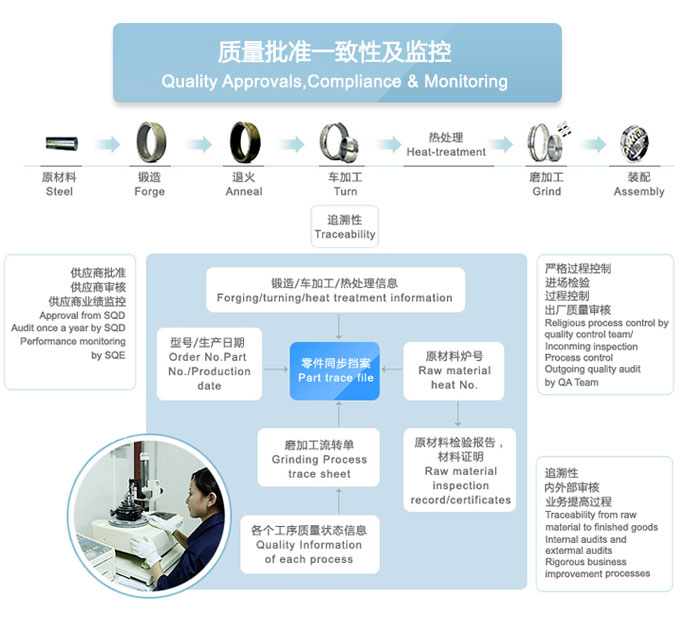
Through the pre quality planning, we have quality management system as the guarantee from the design and development of the products, the purchase of raw materials, the storage and production, to the inspection, packaging and transportation of the finished products.
Noise control (multi-frequency and peaks)

Crack detection

Structure control of the material

Detection of micro burns for inner and outer rings.
Groove Ball Bearing Quality Control – Trusted Inspection
Precision You Can Depend On
At Groove Ball Bearing, quality is the foundation of everything we do. Our quality control processes are tailored to meet international requirements, with special attention given to all bearings manufactured in our facility. Quality assurance mechanisms begin with raw material inspection and culminate with final assembly checks.
Comprehensive Testing at Every Stage
Dependable performance of bearings is non-negotiable for you, and for us. In addition to thorough testing at the end of the manufacturing cycle, each product is subjected to rigorous evaluation during various phases of production. Our in-house quality control system includes:
- Inspection of Materials: Test all steel received in the form of several batches against bearing-grade standards using bearing-grade standards-compliant chemical and structural analysis.
- Accuracy of Dimensions Assessment: Confirming components against intended value by use of CNC coordinate measuring machines and micrometers to accurate measure components against specified tolerances.
- Finish (Surface and Precise Shaping) Evaluation: Carrying out Rockwell hardness tests and surface roughness testing to matrix of wear resistance.
- Noise and Vibration Evaluation: Confirm absence of vibration and sound during operation for automotive and motor applications, especially.
- Test of rotational power against load applied: Conditioning the bearings dynamically to simulate working conditions and validating operated with conditions against ability to carry load without qualitative change in performance.
Questions that help before the next bearing decision after Quality Control
Which next options usually help after reviewing Quality Control?
Most buyers benefit from one broader family destination, one more commercial route, and one supporting guide that answers the next practical question. That combination usually turns research into a clearer shortlist.
Why add related bearing destinations beside Quality Control?
Because the first answer often leads to a second question about fit, applications, supplier choice, or repeat-order confidence. Keeping those next destinations close reduces unnecessary backtracking.
When is it worth moving from reading into a quote or product review?
That move usually makes sense once the topic has narrowed the likely bearing family and the remaining unknowns are commercial, dimensional, or application-specific rather than purely educational.
What usually makes the next bearing decision easier after Quality Control?
The process is often easier when the wider family view, the more commercial destination, and one practical guide stay visible together. That keeps the decision grounded in both application detail and buying reality.
Buyer FAQ
Questions buyers ask before choosing the next bearing option
What can buyers verify from Quality Control?
Quality Control helps buyers review the company background, factory capability, quality process, or business support behind a bearing order before they send requirements.
Why does factory and quality information matter for bearing sourcing?
Bearings are specification-driven parts. Factory and quality information helps buyers understand whether production, inspection, and repeat-order controls can support the required dimensions, noise level, vibration level, material, and packaging.
Can this information help with OEM or custom bearing decisions?
Yes. OEM and custom decisions are stronger when buyers can review production capability, inspection steps, testing equipment, and the type of details required before a drawing or sample is quoted.
What should I check before choosing a bearing supplier?
Check the bearing families offered, factory experience, quality-control process, communication route, export support, ability to review drawings, and whether the supplier can keep repeat specifications consistent.
What is the best next step after reviewing company proof?
Prepare the bearing number, drawing, sample photo, application, quantity, and working conditions, then contact the team for specification review, quote, and lead-time confirmation.
Need help checking fit, price, or lead time? Request a bearing quote