


Blog
Electrical Motor Bearings
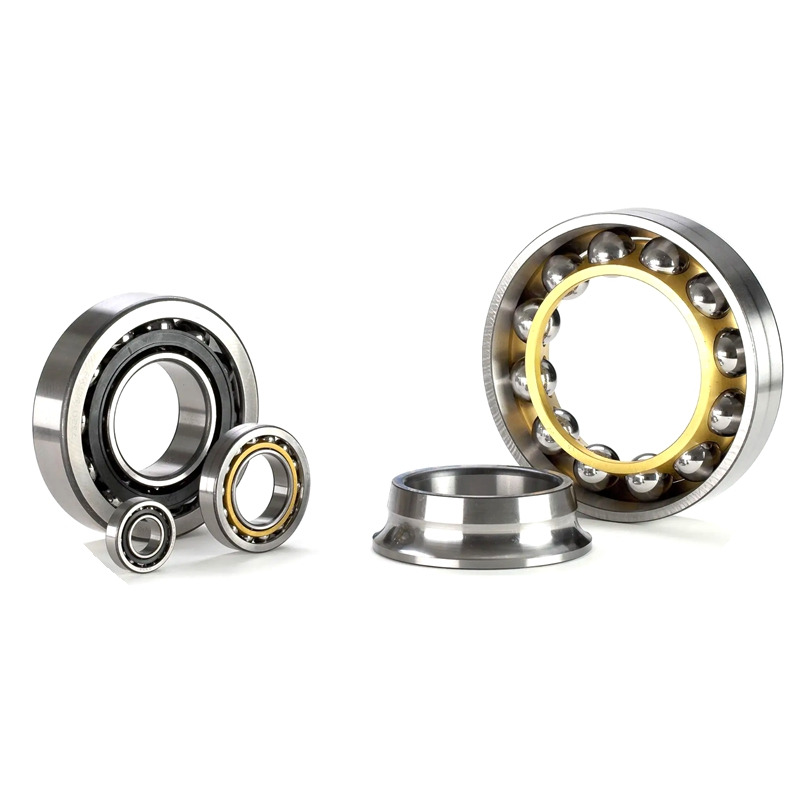
Electrical Motor Bearings Introduction:
Electrical Motor Bearings- For rotating electrical motors (what are electrical motors?), bearings are very important components. Their performance and life directly affect the performance and life of the motor.
Improving the performance and quality of bearings is an important aspect to ensure the stable and reliable operation of the motor.
Motor Bearings Classification:
The rolling bearings commonly used in motors are deep groove ball bearings(for example 6203-2Z/C3, 6005 ), angular contact ball bearings, cylindrical roller bearings, and spherical roller bearings.
1. Deep groove ball bearings are generally used for bearings at both ends of small motors; angular contact ball bearings are also used in some parts.
2. Medium-sized motors generally use roller bearings at the load end and ball bearings at the non-load end.
3. Large motors generally use spherical roller bearings.
Performance Requirements:
The main use requirements of motor bearings are no abnormal sound, low vibration, low noise, low temperature rise and long life.
No abnormal sound mainly requires that there is no abnormal sound caused by sliding friction during the operation of the bearing.
After the machine is installed, run the machine without load, and distinguish the abnormal sound other than electromagnetic sound and fan sound by listening.
Vibration and noise are the most important requirements for bearings. After installation, the vibration value of the whole machine must meet the factory requirements.
Lubrication:
Motor bearings are generally lubricated with grease and oil, and a few of them are self-lubricated. In most general purpose motors, sealed grease lubricated bearings are widely used.
| Item | Grease Lubrication | Oil Lubrication |
| Sealing System | sample | complicated, need to pay attention to the maintenance |
| Lubrication Performance | good | good |
| Rotating Speed | low speed | medium speed and high speed |
| Torque | large | small |
| Lubricant Replacement | complicated | sample |
| Lubricant Life | short | long |
| Cooling Effect | no | good (requires loop) |
| Filtration of Impurities | difficult | easy |
| Leakage of Lubricant | less oil leakage and less pollution | not suitable for places where oil leakage is not allowed |
Clearance:
Usually, we select the same clearance bearings at both ends of the motor. Theoretically, the bearing operates best in a state of close to zero clearance under working conditions. Considering the tolerance factors of assembled parts, it is almost impossible to achieve this requirement. If an axially acting spring element is used to adjust the bearing, play-free operation can also be achieved, but the formation of the bearing contact angle will reduce the load capacity of the bearing. Bearing clearance generally includes radial and axial directions (we only focus on radial clearance for cylindrical roller bearing).
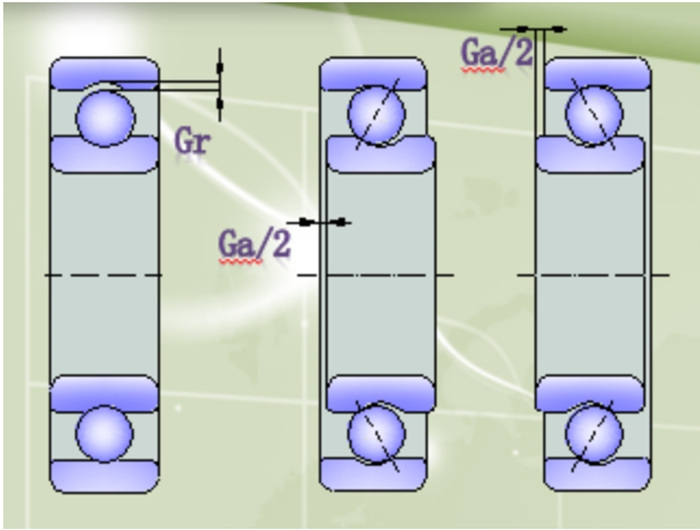
Gr—-Radial clearance
Ga—-Axial clearance
Contact Us:
If you have any questions of Electrical Motor Bearings, pls feel free to contact us!
Questions that help before the next bearing decision after Electrical Motor Bearings
Which next options usually help after reviewing Electrical Motor Bearings?
Most buyers benefit from one broader family destination, one more commercial route, and one supporting guide that answers the next practical question. That combination usually turns research into a clearer shortlist.
Why add related bearing destinations beside Electrical Motor Bearings?
Because the first answer often leads to a second question about fit, applications, supplier choice, or repeat-order confidence. Keeping those next destinations close reduces unnecessary backtracking.
When is it worth moving from reading into a quote or product review?
That move usually makes sense once the topic has narrowed the likely bearing family and the remaining unknowns are commercial, dimensional, or application-specific rather than purely educational.
What usually makes the next bearing decision easier after Electrical Motor Bearings?
The process is often easier when the wider family view, the more commercial destination, and one practical guide stay visible together. That keeps the decision grounded in both application detail and buying reality.
Buyer FAQ
Questions buyers ask before choosing the next bearing option
What is the main takeaway from Electrical Motor Bearings?
The main takeaway is that electrical motor bearings should be checked against the bearing family, dimensions, load direction, speed, and operating conditions instead of relying on the title or size alone.
When should I use this guide before requesting a quote?
Use the guide when you are comparing bearing models, checking suffix meanings, confirming seal or clearance choices, planning maintenance, or preparing details for replacement, production, or OEM sourcing.
How does this topic connect to bearing supply?
The topic supports the Bearing Supply decision path by helping buyers understand fit, performance, specification details, or maintenance factors before choosing a product page or contacting the team.
Can this guide replace a final specification check?
No. The guide helps prepare the decision, but a final check should still confirm the part number, dimensions, load, speed, seal, clearance, precision, application, and order quantity.
What should I send if I need help after reading this guide?
Send the bearing number, measured size, photos if available, application, quantity, and any special operating conditions. That gives the team enough context to recommend the right product family or quote route.
Need help checking fit, price, or lead time? Request a bearing quote