


Machine Tool Bearings
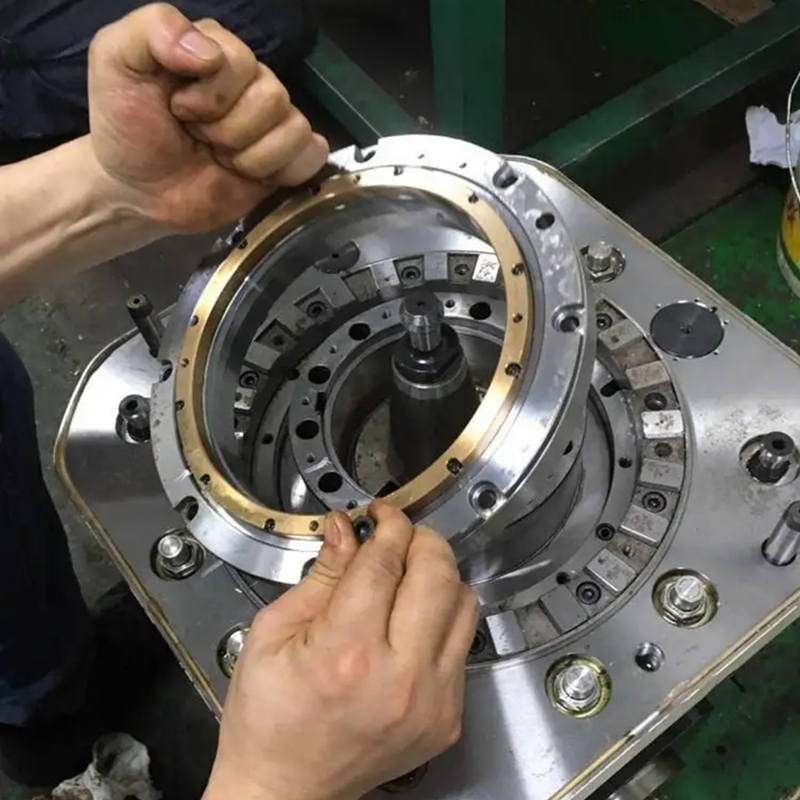
Machine Tool Bearings Introduction:
Machine tool bearings mainly include precision spindle bearings, screw support bearings, and rotary table combined bearings.
Precision Spindle Bearings:
Precision spindle bearings are designed and developed for all kinds of precision machine tool spindles and other high-speed and high-precision occasions. Each type of bearing has its own characteristics and is suitable for different operating conditions. Precision spindle bearing series currently mainly include precision angular contact ball bearing series ( for example HCB7014-C-T-P4S-UL), precision cylindrical roller bearing series, bidirectional thrust angular contact ball bearing, and precision tapered roller bearing.
Advantages:
High Speed
With the development of tool materials and automation, the spindle speed has reached more than 30000r/min.
Low Temperature Rise
Temperature rise is the limiting factor for high speeds and depends on bearing type, arrangement, clearance, etc.
High Load Capacity
Heavy machine tool requirements
Long Life
The life of the spindle bearing usually refers to the period of use to maintain accuracy. During this period, the spindle bearing must not lose its design accuracy.
High Stiffness
The stiffness directly affects the deformation of the part and the re-mapping error of the machined surface, and also affects the self-excited vibration.
High Vibration Resistance
Vibration resistance includes the ability to resist forced vibration and the ability to resist self-excited vibration.
Low Noise
Machine Tool Bearings – Screw Support Bearings:
Precision screw bearings are mainly divided into two categories: thrust angular contact ball bearings and combined bearings
Thrust Angular Contact Ball Bearings:
Thrust angular contact ball bearings have high axial support stiffness and stroke accuracy, and have low friction torque.
Features:
- Large axial load capacity
- Accuracy class: P5, P4, P2
- PA66 cage, thin and light design, reduce damping
- With high axial stiffness and stroke accuracy
- Mirror finish for lower friction torque and lower noise levels
- Axial high rigidity design makes it adaptable to axial and radial feed adjustment
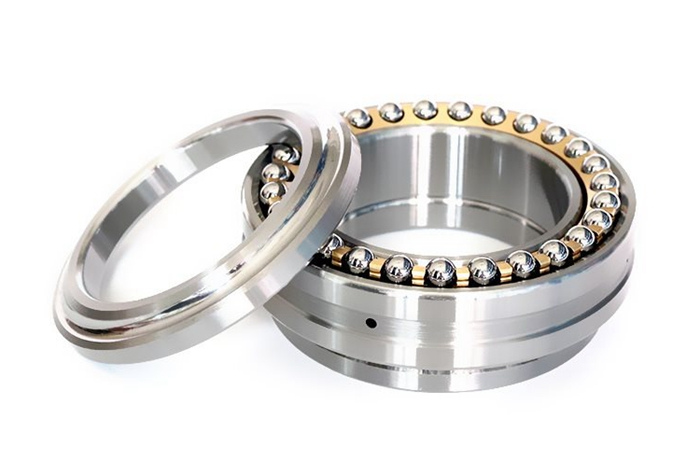
thrust angular contact ball bearing
Combined Bearings:
The combined bearing is a combination of needle rollers and bidirectional thrust cylindrical rollers, so that the resulting bearing can bear bidirectional axial and radial loads, and has high precision and rigidity. Combined bearings are mainly divided into two types: ZARN type and ZARF type.
ZARN type (for example ZARN3570-L-TV) is a combined needle roller and bidirectional thrust cylindrical roller bearing, which is suitable for screw support such as CNC machining centers.
ZARF type (for example ZARF45105-TV) is a combined needle roller and bidirectional thrust cylindrical roller bearing with flange, and the outer ring is used for flange mounting.
Features:
- Bearing ring is made of high-quality and high-purity bearing steel to prolong the service life of the bearing
- Bearing ring is stabilized to ensure a small deformation of the bearing to maintain the high precision and long life
- Cylindrical roller bearing part adopts glass fiber reinforced nylon 66 cage, high pressure injection molding
- The cage of the needle roller bearing generally adopts the self-locking structure of stamped steel plate, and at the same time, glass fiber reinforced nylon 66 can also be used
- Bearing raceway adopts mirror surface processing technology, which can effectively reduce the friction torque by 30% and prolong bearing service life
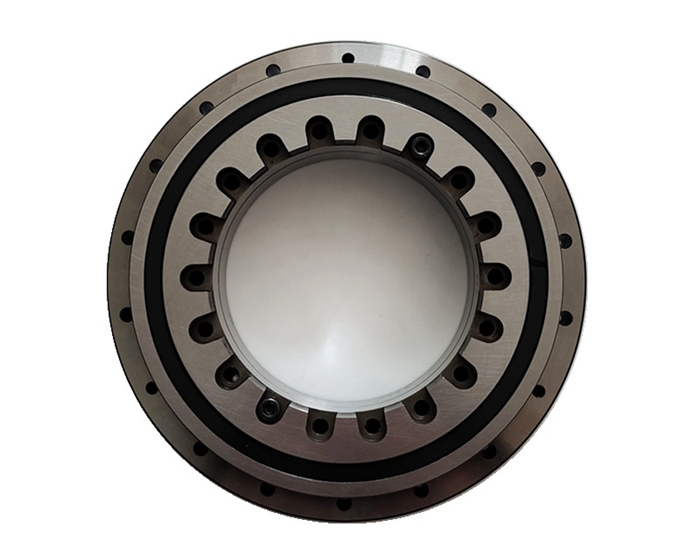
Rotary Table Combined Bearings:
The rotary table combined bearing is a large combined bearing with a special structure that integrates various functions such as support, rotation, transmission and fixation.
Under normal circumstances, rotary table bearing itself has mounting holes, lubricating oil grooves, and oil holes, which can meet the different needs of various types of hosts working under various working conditions.
Features:
- Bearing can withstand bidirectional axial and radial loads with high accuracy and rigidity
- With compact structure, easy to guide and rotate, easy to install such features, rotary table bearings are widely used in the rotary device of large machine tools
- The optimized cage guiding method improves the bearing rotation performance, and has the characteristics of high speed, high rigidity and low friction
- Special heat treatment process reduces self-deformation ability and improves precision life
- Accuracy class higher than P4
Contact Us:
If you have any questions of Machine Tool Bearings, please feel free to contact us. We will give your reply within 12 hours!
Questions that help before the next bearing decision after Machine Tool Bearings
Which next options usually help after reviewing Machine Tool Bearings?
Most buyers benefit from one broader family destination, one more commercial route, and one supporting guide that answers the next practical question. That combination usually turns research into a clearer shortlist.
Why add related bearing destinations beside Machine Tool Bearings?
Because the first answer often leads to a second question about fit, applications, supplier choice, or repeat-order confidence. Keeping those next destinations close reduces unnecessary backtracking.
When is it worth moving from reading into a quote or product review?
That move usually makes sense once the topic has narrowed the likely bearing family and the remaining unknowns are commercial, dimensional, or application-specific rather than purely educational.
What usually makes the next bearing decision easier after Machine Tool Bearings?
The process is often easier when the wider family view, the more commercial destination, and one practical guide stay visible together. That keeps the decision grounded in both application detail and buying reality.
Buyer FAQ
Questions buyers ask before choosing the next bearing option
What is the main takeaway from Machine Tool Bearings?
The main takeaway is that machine tool bearings should be checked against the bearing family, dimensions, load direction, speed, and operating conditions instead of relying on the title or size alone.
When should I use this guide before requesting a quote?
Use the guide when you are comparing bearing models, checking suffix meanings, confirming seal or clearance choices, planning maintenance, or preparing details for replacement, production, or OEM sourcing.
How does this topic connect to bearing supply?
The topic supports the Bearing Supply decision path by helping buyers understand fit, performance, specification details, or maintenance factors before choosing a product page or contacting the team.
Can this guide replace a final specification check?
No. The guide helps prepare the decision, but a final check should still confirm the part number, dimensions, load, speed, seal, clearance, precision, application, and order quantity.
What should I send if I need help after reading this guide?
Send the bearing number, measured size, photos if available, application, quantity, and any special operating conditions. That gives the team enough context to recommend the right product family or quote route.
Need help checking fit, price, or lead time? Request a bearing quote