


Static Load vs. Dynamic Load in Bearings
Static Load vs. Dynamic Load in Bearings: Why the Difference Matters?
Static load vs. dynamic load in bearings directly affects how a bearing runs, how long it lasts, and which type you should select. Many people confuse the two because both place force on the bearing. The real difference comes from motion and the dominant failure mode. Static load relates to permanent deformation and denting risk. Dynamic load relates to rolling contact fatigue and bearing life. Here’s a clear breakdown.
What “Load” Means in a Bearing?
A bearing load is the force the bearing must carry.
You will see two main directions:
1.Radial load: force perpendicular to the shaft.
2.Axial (thrust) load: force along the shaft.
Most applications apply combined load. That means radial + axial at the same time.
Static Load in Bearings:
Static load relates to no rotation or very slow motion.
What “static” really means?
Static does not always mean “never moves.” It often means:
- the bearing stands still, or
- it rotates slowly, or
- it moves back and forth over a tiny angle, or
- it holds load for long periods.
The key risk: dents and permanent deformation:
Static load can overload the contact between rolling elements and raceways.
That contact can leave:
- permanent indentations (brinelling), or
- microscopic plastic deformation that raises noise and vibration.
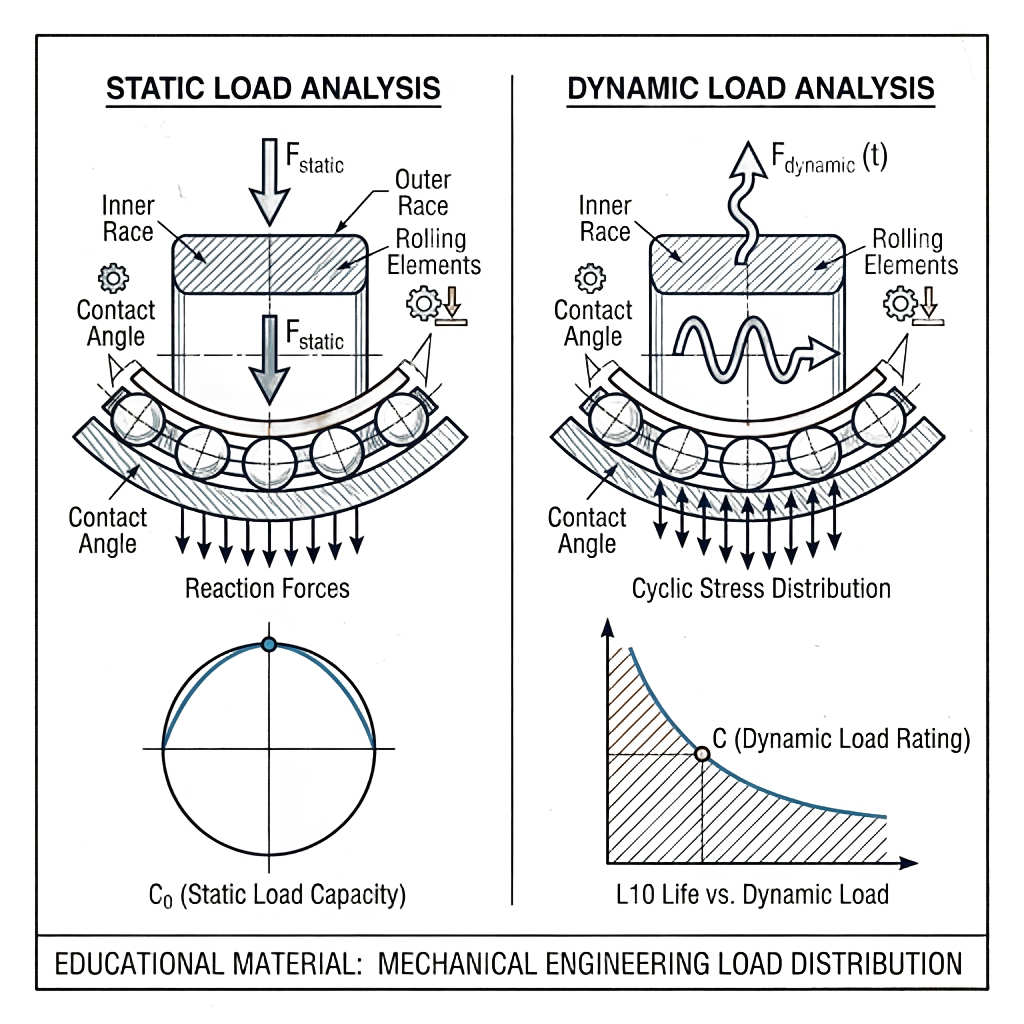
Static load rating: C0
Manufacturers publish the basic static load rating, written as C0.
Think of C0 as:
- a limit tied to permanent deformation, not fatigue life.
When static load matters most:
Static load becomes the main check when you have:
- heavy loads at standstill (cranes, jacks, turntables)
- shock loads (hammering, impacts, potholes)
- frequent stops and starts
- very low speed operation
- vibration at rest (false brinelling risk)
Dynamic Load in Bearings:
Dynamic load relates to rotation and fatigue.
The key risk: rolling contact fatigue
When a bearing rotates under load, the stress repeats at the raceway contacts.
Over time, the material can crack. Then it can flake. People call that spalling.
Dynamic load rating: C
Manufacturers publish the basic dynamic load rating, written as C.
Think of C as:
- a capacity tied to fatigue life under rolling conditions.
When dynamic load matters most:
Dynamic load becomes the main check when you have:
- continuous rotation
- moderate to high speeds
- long required service life
- stable running with low vibration targets
Static vs. Dynamic: The Practical Difference:
Here’s the clean way to separate them:
| Topic | Static Load | Dynamic Load |
|---|---|---|
| Main situation | Standstill or very low motion | Rotation under load |
| Main failure mode | Permanent deformation, brinelling | Fatigue, spalling |
| Catalog rating | C0 | C |
| What you protect | Geometry and smoothness | Life in cycles/hours |
| Typical checks | Static safety factor s0 | Life L10 or hours |
How to Choose the Right Rating to Focus On?
Focus on C0 when you have:
- heavy load at standstill
- shocks
- very low speed
- oscillating motion
- long dwell time under load
Focus on C and life when you have:
- continuous rotation
- defined speed and duty cycle
- target life in hours
- steady loads
In a nutshell, static load links to permanent deformation. Check C0. Dynamic load links to fatigue life. Check C and calculate life. Many applications need both checks. Shocks, vibration, misalignment, and preload can wreck your assumptions fast.
Questions that usually come up after Static Load vs. Dynamic Load in Bearings
Which next options usually help after reviewing Static Load vs. Dynamic Load in Bearings?
Most buyers benefit from one broader family destination, one more commercial route, and one supporting guide that answers the next practical question. That combination usually turns research into a clearer shortlist.
Why add related bearing destinations beside Static Load vs. Dynamic Load in Bearings?
Because the first answer often leads to a second question about fit, applications, supplier choice, or repeat-order confidence. Keeping those next destinations close reduces unnecessary backtracking.
When is it worth moving from reading into a quote or product review?
That move usually makes sense once the topic has narrowed the likely bearing family and the remaining unknowns are commercial, dimensional, or application-specific rather than purely educational.
What usually makes the next bearing decision easier after Static Load vs. Dynamic Load in Bearings?
The process is often easier when the wider family view, the more commercial destination, and one practical guide stay visible together. That keeps the decision grounded in both application detail and buying reality.
Buyer FAQ
Questions buyers ask before choosing the next bearing option
What is the main takeaway from Static Load vs. Dynamic Load in Bearings?
The main takeaway is that static load vs. dynamic load in bearings should be checked against the bearing family, dimensions, load direction, speed, and operating conditions instead of relying on the title or size alone.
When should I use this guide before requesting a quote?
Use the guide when you are comparing bearing models, checking suffix meanings, confirming seal or clearance choices, planning maintenance, or preparing details for replacement, production, or OEM sourcing.
How does this topic connect to bearing supply?
The topic supports the Bearing Supply decision path by helping buyers understand fit, performance, specification details, or maintenance factors before choosing a product page or contacting the team.
Can this guide replace a final specification check?
No. The guide helps prepare the decision, but a final check should still confirm the part number, dimensions, load, speed, seal, clearance, precision, application, and order quantity.
What should I send if I need help after reading this guide?
Send the bearing number, measured size, photos if available, application, quantity, and any special operating conditions. That gives the team enough context to recommend the right product family or quote route.
Need help checking fit, price, or lead time? Request a bearing quote