


Cylindrical Roller Bearings Introduction
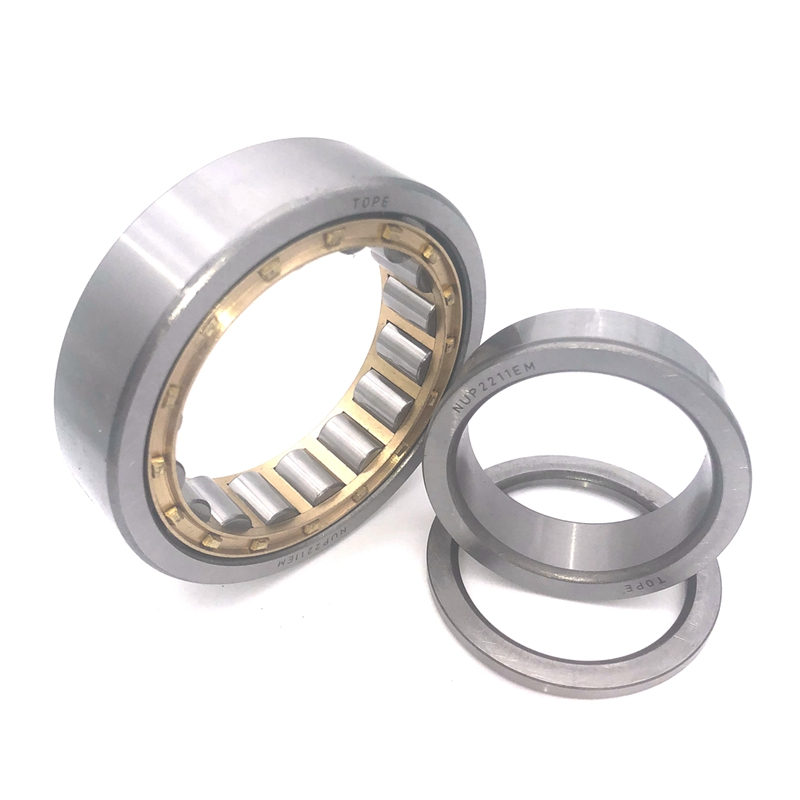
Basic Introduction:
Cylindrica roller bearing is radial rolling bearing. Cylindrical rollers and raceways are linear contact bearings.
Cylindrical roller bearings mainly bear radial load. The friction between the rolling element and the retaining edge of the ring is small, therefore, it is suitable for high-speed rotation.
According to whether the ring has ribs, it can be divided into single row bearings and double row bearings.
Single row bearings include NU, NJ, NUP, N, NF, and double row bearings include NNU and NN.
Features of cylindrical roller bearings:
1. The roller and the raceway are in line contact or under-line contact, with large radial bearing capacity. As a result, it is suitable for bearing heavy loads and impact loads.
2. The friction coefficient is small, which is suitable for high speed, and the limit speed is close to the deep groove ball bearing.
3. N type and NU type can move axially. Therefore, it can adapt to the change of the relative position of shaft and housing caused by thermal expansion or installation error.
Moreover, it can be used as free end support.
4. The processing requirements for the shaft or the seat hole are relatively high. After users install bearings, the relative deflection of the outer ring axis should be strictly controlled to avoid contact stress concentration.
5. Users can separate inner ring and outer ring without difficulty.
Application of cylindrical roller bearings:
Cylindrical bearings are widely used on many applications.
For example, large and medium-sized electric motors, rolling stock, machine tool spindles, internal combustion engines, generators, gas turbines, gearboxes, rolling mills, vibrating screens, lifting and transporting machinery, etc.
Bearing Construction:
1. N0000 and NU0000 type cylindrical roller bearings which without ribs on the outer ring and inner ring can load large radial loads. Moreover, N0000 and NU0000 type bearings have high limit speed and cannot accept axial loads.
2. NJ0000 and NF0000 cylindrical roller bearings with ribs on both inner and outer rings can restrain the axial displacement of the shaft or housing in one direction. Therefore, NJ0000 and NF0000 type cylindrical roller bearings can accept small unidirectional axial loads.
3. NU0000+HJ0000, NJ0000+HJ0000, NUP0000 type bearings can restrain the axial displacement of the shaft or the shell in the axial clearance area of bearing. And NU0000+HJ0000, NJ0000+HJ0000, NUP0000 type bearings can accept small two-way axial load.
Useful guides
Cylindrical roller bearing guides for high radial-load applications
Use these guides when the bearing family is already close, but the final choice still depends on load, speed, environment, layout, or replacement context.
Full Complement vs Cage-Guided Cylindrical Roller Bearings: Which Option Fits the Job?
A comparison guide that helps buyers narrow the bearing style, material, or layout before choosing a supply route.
How Cylindrical Roller Bearings Support High Radial Loads Without Sacrificing Speed
A buyer-facing guide that supports bearing selection, quote preparation, and technical discussion before ordering.
Tapered, Cylindrical, and Spherical Roller Bearings: Which Design Solves Which Problem?
A buyer-facing guide that supports bearing selection, quote preparation, and technical discussion before ordering.
Industrial Repairs Depend on a Cylindrical Roller Bearing Manufacturer wi…
A sourcing guide for checking supplier fit, repeat-order support, specification review, and communication before purchasing.
Questions that help before the next bearing decision after Cylindrical Roller Bearings Introduction
Which next options usually help after reviewing Cylindrical Roller Bearings Introduction?
Most buyers benefit from one broader family destination, one more commercial route, and one supporting guide that answers the next practical question. That combination usually turns research into a clearer shortlist.
Why add related bearing destinations beside Cylindrical Roller Bearings Introduction?
Because the first answer often leads to a second question about fit, applications, supplier choice, or repeat-order confidence. Keeping those next destinations close reduces unnecessary backtracking.
When is it worth moving from reading into a quote or product review?
That move usually makes sense once the topic has narrowed the likely bearing family and the remaining unknowns are commercial, dimensional, or application-specific rather than purely educational.
What usually makes the next bearing decision easier after Cylindrical Roller Bearings Introduction?
The process is often easier when the wider family view, the more commercial destination, and one practical guide stay visible together. That keeps the decision grounded in both application detail and buying reality.
Buyer FAQ
Questions buyers ask before choosing the next bearing option
What is the main takeaway from Cylindrical Roller Bearings Introduction?
The main takeaway is that cylindrical roller bearings introduction should be checked against the bearing family, dimensions, load direction, speed, and operating conditions instead of relying on the title or size alone.
When should I use this guide before requesting a quote?
Use the guide when you are comparing bearing models, checking suffix meanings, confirming seal or clearance choices, planning maintenance, or preparing details for replacement, production, or OEM sourcing.
How does this topic connect to cylindrical roller bearings?
The topic supports the Cylindrical Roller Bearings decision path by helping buyers understand fit, performance, specification details, or maintenance factors before choosing a product page or contacting the team.
Can this guide replace a final specification check?
No. The guide helps prepare the decision, but a final check should still confirm the part number, dimensions, load, speed, seal, clearance, precision, application, and order quantity.
What should I send if I need help after reading this guide?
Send the bearing number, measured size, photos if available, application, quantity, and any special operating conditions. That gives the team enough context to recommend the right product family or quote route.
Need help checking fit, price, or lead time? Request a bearing quote