


Full Complement Cylindrical Roller Bearings
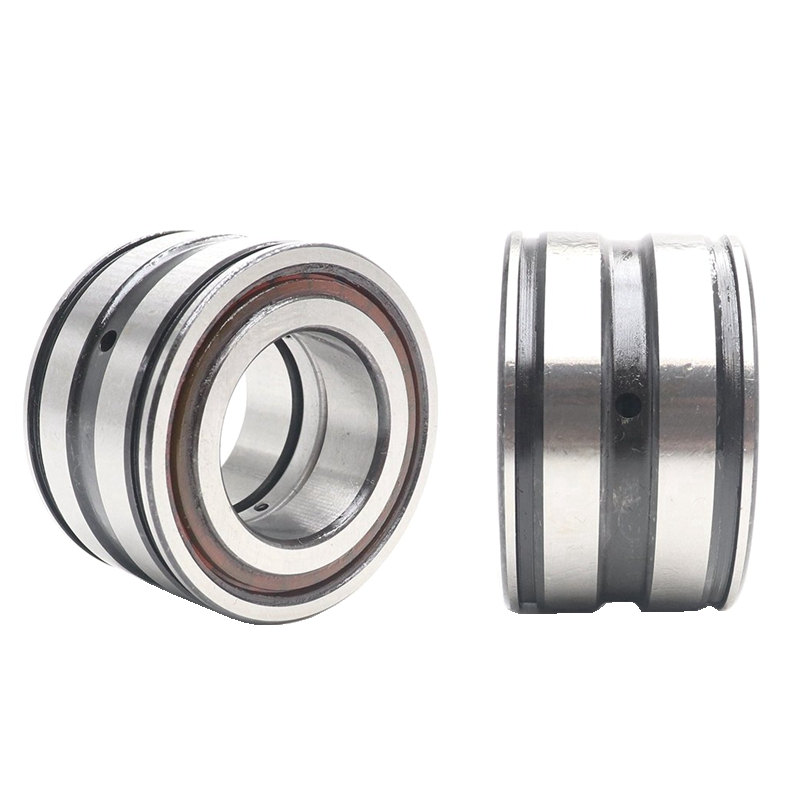
Full Complement Cylindrical Roller Bearings Design:
Full complement cylindrical roller bearings are suitable for bearing heavy loads.
Under the same width, this kind of bearing has extremely high load carrying capacity compared with the traditional bearing with cage, the radial section is small, it can save space, but the speed is relatively low.
In order to make the bearing work normally, in the case of continuous operation, the bearing must bear a certain minimum load, that is, C/P<25.
Otherwise, wear will increase due to insufficient lubrication and high-speed operation.
All multi-row cylindrical roller bearings have a lubrication groove and a lubrication hole on the outer ring.
Bearing Structure:
A full complement cylindrical roller bearing has two inner rings. The two inner rings are connected by a clamping ring and cannot separate. The outer ring has a middle rib, which can bear bidirectional axial load and plays the role of a positioning bearing.
Due to the large distance between the two rows of rollers, they can also withstand overturning moments.
There are two stop grooves on the surface of the outer ring, which can be put axially.
This type of bearing is equipped with contact seal rings on both sides, and lithium-based grease is installed inside.
The operating temperature is -40°C to +80°C.
Under certain conditions, this type of bearing does not require maintenance, but when there is water vapor or pollution during operation, and it is often revolve at medium or high speeds, it must be relubricated.
When using oil lubrication, it is necessary to remove the sealing ring and clean the grease in the bearing.
When using oil lubrication, the rotation rate will increase by 30%.
Bearing Clearance:
The dimensional tolerances and geometric deviations of full complement cylindrical roller bearings should comply with GB/T307.1-94 (ISO492-1994) P0 tolerance level.
In addition, the original radial clearance CO is normal.
However, radial clearance C2 to C4 may also be required.
Rubber and plastic screw extruders generally use C3 group clearance.
The fit tolerance can refer to the selection principle of bearing seat tolerance and the selection principle of shaft tolerance limit.
Full Complement Cylindrical Roller Bearings Size Chart:
| Bearing NO. | Bearing NO. | Weight | Size | Basic load ratings | |||||
| d | D | B | C | Cr | KN | Co | |||
| NNF5004-ZLSNV | SL04 5004 PP | 0.2 | 20 | 42 | 30 | 29 | 40.5 | 49 | 4000 |
| NNF5005-ZLSNV | SL04 5005 PP | 0.24 | 25 | 47 | 30 | 29 | 44.5 | 58 | 3600 |
| NNF5006-ZLSNV | SL04 5006 PP | 0.37 | 30 | 55 | 34 | 33 | 50 | 67 | 3000 |
| NNF5007-ZLSNV | SL04 5007 PP | 0.48 | 35 | 62 | 36 | 35 | 63 | 88 | 2600 |
| NNF5008-ZLSNV | SL04 5008 PP | 0.56 | 40 | 68 | 38 | 37 | 76 | 103 | 2400 |
| NNF5009-ZLSNV | SL04 5009 PP | 0.7 | 45 | 75 | 40 | 39 | 92 | 130 | 2200 |
| NNF5010-ZLSNV | SL04 5010 PP | 0.76 | 50 | 80 | 40 | 39 | 97 | 142 | 2000 |
| NNF5011-ZLSNV | SL04 5011 PP | 1.18 | 55 | 90 | 46 | 45 | 115 | 175 | 1800 |
| NNF5012-ZLSNV | SL04 5012 PP | 1.26 | 60 | 95 | 46 | 45 | 120 | 189 | 1700 |
| NNF5013-ZLSNV | SL04 5013 PP | 1.33 | 65 | 100 | 46 | 45 | 125 | 203 | 1600 |
| NNF5014-ZLSNV | SL04 5014 PP | 1.87 | 70 | 110 | 54 | 53 | 168 | 265 | 1400 |
| NNF5015-ZLSNV | SL04 5015 PP | 1.96 | 75 | 115 | 54 | 53 | 194 | 300 | 1400 |
| NNF5016-ZLSNV | SL04 5016 PP | 2.71 | 80 | 125 | 60 | 59 | 203 | 325 | 1300 |
| NNF5017-ZLSNV | SL04 5017 PP | 2.83 | 85 | 130 | 60 | 59 | 211 | 350 | 1200 |
| NNF5018-ZLSNV | SL04 5018 PP | 3.71 | 90 | 140 | 67 | 66 | 305 | 510 | 1100 |
| NNF5019-ZLSNV | SL04 5019 PP | 3.88 | 95 | 145 | 67 | 66 | 315 | 530 | 1100 |
| NNF5020-ZLSNV | SL04 5020 PP | 3.95 | 100 | 150 | 67 | 66 | 330 | 550 | 1000 |
| Bearing NO. | Bearing NO. | Weight | Size | Basic load ratings | |||||
| d | D | B | C | Cr | KN | Co | |||
| NNF5022-ZLSNV | SL04 5022 PP | 6.57 | 110 | 170 | 80 | 79 | 395 | 680 | 900 |
| NNF5024-ZLSNV | SL04 5024 PP | 7.04 | 120 | 180 | 80 | 79 | 410 | 740 | 900 |
| NNF5026-ZLSNV | SL04 5026 PP | 10.5 | 130 | 200 | 95 | 94 | 540 | 960 | 800 |
| NNF130-ZLSNV | SL04 130 PP | 7.5 | 130 | 190 | 80 | 79 | 430 | 790 | 800 |
| NNF5028ZLSNV | SL04 5028 PP | 11.1 | 140 | 210 | 95 | 94 | 610 | 1100 | 750 |
| NNF140-ZLSNV | SL04 140 PP | 8 | 140 | 200 | 80 | 79 | 445 | 840 | 750 |
| NNF5030-ZLSNV | SL04 5030 PP | 13.3 | 150 | 225 | 100 | 99 | 710 | 1260 | 700 |
| NNF150-ZLSNV | SL04 150 PP | 8.4 | 150 | 210 | 80 | 79 | 465 | 920 | 700 |
| NF5032-ZLSNV | SL04 5032 PP | 16.6 | 160 | 240 | 109 | 108 | 740 | 1360 | 650 |
| NNNF160-ZLSNV | SL04 160 PP | 8.8 | 160 | 220 | 80 | 79 | 480 | 970 | 700 |
| NNF5034-ZLSNV | SL04 5034 PP | 22.6 | 170 | 260 | 122 | 121 | 960 | 1750 | 600 |
| NNF170-ZLSNV | SL04 170 PP | 9.3 | 170 | 230 | 80 | 79 | 490 | 1030 | 650 |
| NNF5036-ZLSNV | SL04 5036 PP | 30.1 | 180 | 280 | 136 | 135 | 1140 | 2130 | 550 |
| NNF180-ZLSNV | SL04 180 PP | 9.8 | 180 | 240 | 80 | 79 | 500 | 1080 | 600 |
| NNF5038-ZLSNV | SL04 5038 PP | 31.5 | 190 | 290 | 136 | 135 | 1160 | 2210 | 550 |
| NNF190-ZLSNV | SL04 190 PP | 12.7 | 190 | 260 | 80 | 79 | 520 | 1130 | 550 |
| NNF5040-ZLSNV | SL04 5040 PP | 40.8 | 200 | 310 | 150 | 149 | 1350 | 2600 | 500 |
| NNF200-ZLSNV | SL04 200 PP | 13.2 | 200 | 270 | 80 | 79 | 540 | 1210 | 550 |
| NNF5044-ZLSNV | SL04 5044 PP | 52.5 | 220 | 340 | 160 | 159 | 1570 | 3050 | 480 |
| NNF220-ZLSNV | SL04 220 PP | 19.5 | 220 | 300 | 95 | 94 | 700 | 1550 | 480 |
| NNF5048-ZLSNV | SL04 5048 PP | 56 | 240 | 360 | 160 | 159 | 1630 | 3300 | 440 |
| NNF240-ZLSNV | SL04 240 PP | 21 | 240 | 320 | 95 | 94 | 740 | 1700 | 480 |
| NNF5052-ZLSNV | SL04 5052 PP | 84.5 | 260 | 400 | 190 | 189 | 2380 | 4700 | 400 |
| NNF260-ZLSNV | SL04 260 PP | 22.5 | 260 | 340 | 95 | 94 | 840 | 1990 | 440 |
| NNF5056-ZLSNV | SL04 5056 PP | 90 | 280 | 420 | 190 | 189 | 2600 | 5200 | 380 |
| NNF5060-ZLSNV | SL04 5060 PP | 126 | 300 | 460 | 218 | 216 | 3000 | 5800 | 340 |
| NNF300-ZLSNV | SL04 300 PP | 25.5 | 300 | 380 | 95 | 94 | 900 | 2250 | 380 |
Questions that help before the next bearing decision after Full Complement Cylindrical Roller Bearings
Which next options usually help after reviewing Full Complement Cylindrical Roller Bearings?
Most buyers benefit from one broader family destination, one more commercial route, and one supporting guide that answers the next practical question. That combination usually turns research into a clearer shortlist.
Why add related bearing destinations beside Full Complement Cylindrical Roller Bearings?
Because the first answer often leads to a second question about fit, applications, supplier choice, or repeat-order confidence. Keeping those next destinations close reduces unnecessary backtracking.
When is it worth moving from reading into a quote or product review?
That move usually makes sense once the topic has narrowed the likely bearing family and the remaining unknowns are commercial, dimensional, or application-specific rather than purely educational.
What usually makes the next bearing decision easier after Full Complement Cylindrical Roller Bearings?
The process is often easier when the wider family view, the more commercial destination, and one practical guide stay visible together. That keeps the decision grounded in both application detail and buying reality.
Buyer FAQ
Questions buyers ask before choosing the next bearing option
What is the main takeaway from Full Complement Cylindrical Roller Bearings?
The main takeaway is that full complement cylindrical roller bearings should be checked against the bearing family, dimensions, load direction, speed, and operating conditions instead of relying on the title or size alone.
When should I use this guide before requesting a quote?
Use the guide when you are comparing bearing models, checking suffix meanings, confirming seal or clearance choices, planning maintenance, or preparing details for replacement, production, or OEM sourcing.
How does this topic connect to cylindrical roller bearings?
The topic supports the Cylindrical Roller Bearings decision path by helping buyers understand fit, performance, specification details, or maintenance factors before choosing a product page or contacting the team.
Can this guide replace a final specification check?
No. The guide helps prepare the decision, but a final check should still confirm the part number, dimensions, load, speed, seal, clearance, precision, application, and order quantity.
What should I send if I need help after reading this guide?
Send the bearing number, measured size, photos if available, application, quantity, and any special operating conditions. That gives the team enough context to recommend the right product family or quote route.
Need help checking fit, price, or lead time? Request a bearing quote