


Blog
Eccentric Bearings Introduction
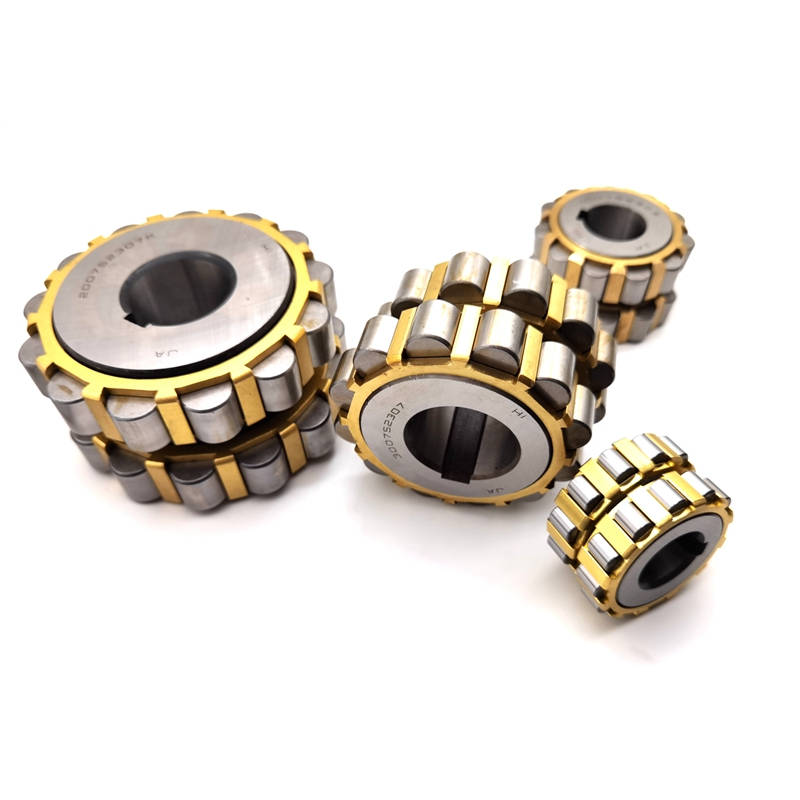
1. Eccentric Bearing Structure
It mainly includes outer ring, inner ring, rolling element basket and rolling element.
The eccentric bearing has a simple structure and is easy to use. As a result, it realizes the eccentric function without eccentric shaft, therefore, it greatly simplifies the eccentric mechanism and saves labor on the eccentric mechanism machining.
Moreover, it is time-saving and easy to assemble, which reduces the manufacturing cost of eccentric mechanism.
2. Eccentric Bearings Feature
The inner hole of the inner ring is an eccentric hole, and there is a longitudinal key groove on the inner side wall of the eccentric hole.
3. Eccentric Bearings Classification
One is a double-layer double-row tapered roller eccentric bearing. The cylindrical roller is a single-layer raceway small clearance or negative clearance cylindrical roller bearing. Users usually install it on both sides of the plate cylinder and impression cylinder of the printing machine.
The other is a double-layer raceway with internal and external eccentric negative clearance cylindrical roller bearing unit, which is installed on both sides of the rubber cylinder of the printing press. Because of its special structure, hollow cylindrical roller bearings have strong vibration absorption capacity, long precision life and overload protection compared with conventional rolling bearings.
4. Eccentric Bearings Application
Eccentric bearings have wide application.
For example, speed reducer, petrochemical, textile, metallurgy, mining, steel mills, light and heavy machinery, etc.
5. Precautions for the Usage
(1) Keep eccentric bearings and their surrounding environment clean.
Even if the invisible smile dust enters the eccentric bearing, it will increase the wear, vibration and noise of the eccentric bearing.
(2) Users must take care during installing and using.
Strong punching is not allowed, hammers are not allowed to directly hit the eccentric bearing, and pressure is not allowed to pass through the rolling elements.
(3) Use appropriate and accurate installation tools.
Try to use special tools, while avoid using cloth and short fibers.
(4) Prevent the rust of the integral eccentric bearings.
When picking the integral eccentric bearing directly by hand, wash away the sweat from your hands and apply high-quality mineral oil before operating. Pay special attention to rust prevention in the rainy season and summer.
Common Bearing Suffixes Meaning:
K: Indicates that the outer diameter of the eccentric bearing has changed.
For example: The outer diameter of 300752904K is 61.80mm.
K2: Indicates that the inner diameter of the bearing has changed.
For example: the inner diameter of 350752904K2 is 19.00mm.
K1: Indicates that the outer diameter and inner diameter of the bearing have changed.
For example: the inner diameter of 300752904K1 is 19.00mm and outer diameter size is 70.00mm.
Y1: The outer diameter size has changed on the basis of the K1 size.
For example: the inner diameter of 300752904Y1 is 19.00mm and outer diameter size is 61.80mm.
Questions that usually come up after Eccentric Bearings Introduction
Which next options usually help after reviewing Eccentric Bearings Introduction?
Most buyers benefit from one broader family destination, one more commercial route, and one supporting guide that answers the next practical question. That combination usually turns research into a clearer shortlist.
Why add related bearing destinations beside Eccentric Bearings Introduction?
Because the first answer often leads to a second question about fit, applications, supplier choice, or repeat-order confidence. Keeping those next destinations close reduces unnecessary backtracking.
When is it worth moving from reading into a quote or product review?
That move usually makes sense once the topic has narrowed the likely bearing family and the remaining unknowns are commercial, dimensional, or application-specific rather than purely educational.
What usually makes the next bearing decision easier after Eccentric Bearings Introduction?
The process is often easier when the wider family view, the more commercial destination, and one practical guide stay visible together. That keeps the decision grounded in both application detail and buying reality.
Buyer FAQ
Questions buyers ask before choosing the next bearing option
What is the main takeaway from Eccentric Bearings Introduction?
The main takeaway is that eccentric bearings introduction should be checked against the bearing family, dimensions, load direction, speed, and operating conditions instead of relying on the title or size alone.
When should I use this guide before requesting a quote?
Use the guide when you are comparing bearing models, checking suffix meanings, confirming seal or clearance choices, planning maintenance, or preparing details for replacement, production, or OEM sourcing.
How does this topic connect to special / other bearings?
The topic supports the Special / Other Bearings decision path by helping buyers understand fit, performance, specification details, or maintenance factors before choosing a product page or contacting the team.
Can this guide replace a final specification check?
No. The guide helps prepare the decision, but a final check should still confirm the part number, dimensions, load, speed, seal, clearance, precision, application, and order quantity.
What should I send if I need help after reading this guide?
Send the bearing number, measured size, photos if available, application, quantity, and any special operating conditions. That gives the team enough context to recommend the right product family or quote route.
Need help checking fit, price, or lead time? Request a bearing quote