


Bearing Noise and Vibration
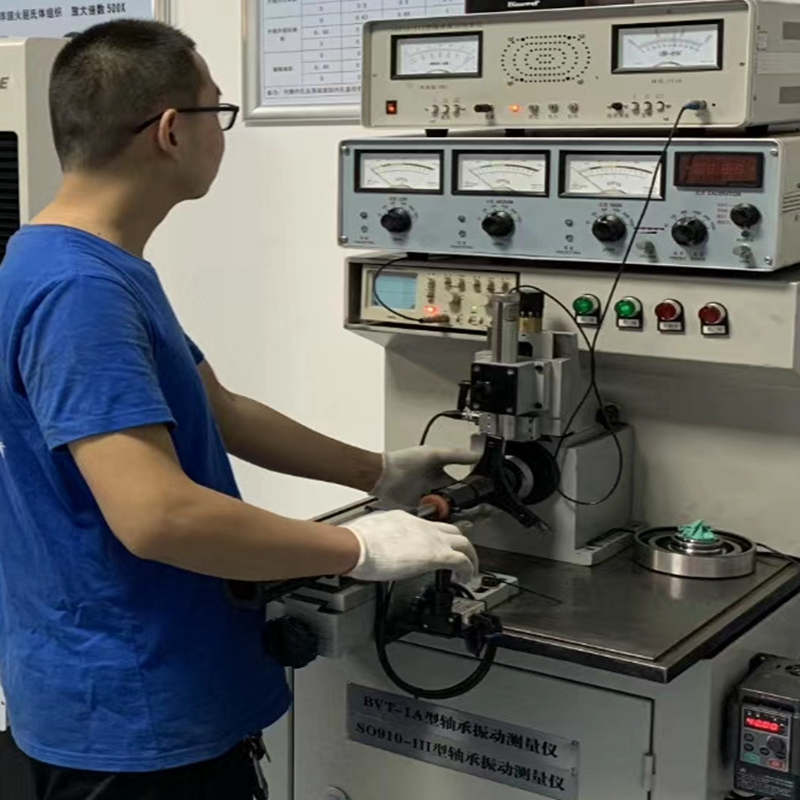
Bearing Noise and Vibration Detection:
Bearing noise and vibration – important metrics for bearing quality
Usually we use instrument S0910-1 to detect the noise of ball bearings.
We devide bearing noise into four levels: Z1, Z2, Z3, and Z4.
The higher the level, the lower the noise.
While for bearing vibriation, we use the instrument BVT-1 to detect.
We divide bearing vibration into four levels: Z1, Z2, Z3, and Z4.
The higher the level, the smaller the vibration.
Noise Levels Parameter Table:
| Bearing Diameter | SO901-1(dB) | |||
| Z1 | Z2 | Z3 | Z4 | |
| ㎜ | ≤ | ≤ | ≤ | ≤ |
| 3 | 34 | 32 | 28 | 23 |
| 4 | 34 | 32 | 28 | 23 |
| 5 | 36 | 34 | 30 | 25 |
| 6 | 36 | 34 | 30 | 25 |
| 7 | 38 | 35 | 31 | 26 |
| 8 | 38 | 35 | 31 | 26 |
| 9 | 40 | 36 | 32 | 27 |
| 10 | 42 | 38 | 33 | 28 |
| 12 | 43 | 39 | 34 | 29 |
| 15 | 44 | 40 | 35 | 30 |
| 17 | 44 | 40 | 35 | 30 |
| 20 | 45 | 41 | 36 | 31 |
| 25 | 46 | 42 | 38 | 33 |
| 30 | 47 | 43 | 39 | 35 |
| 35 | 49 | 45 | 41 | 36 |
| 40 | 51 | 46 | 42 | 38 |
Vibration Levels Parameter Table:
| Diameter | V (um/s) | V1 (um/s) | V2 (um/s) | V3 (um/s) | ||||||||
| d | ||||||||||||
| mm | Low Frequency | Middle Frequency | High frequency | Low frequency | Middle Frequency | High frequency | Low Frequency | Middle Frequency | High frequency | Low Frequency | Middle Frequency | High Frequency |
| 3,4 | 80 | 44 | 44 | 60 | 35 | 32 | 48 | 26 | 22 | 31 | 16 | 10 |
| 5,6 | 110 | 72 | 60 | 74 | 48 | 40 | 58 | 36 | 30 | 35 | 21 | 11 |
| 7,8,9 | 130 | 96 | 80 | 92 | 66 | 54 | 72 | 48 | 40 | 44 | 28 | 12 |
| 10,12 | 160 | 120 | 100 | 120 | 80 | 70 | 90 | 60 | 50 | 55 | 35 | 15 |
| 15 | 210 | 150 | 120 | 150 | 100 | 85 | 110 | 78 | 60 | 65 | 46 | 18 |
| 17 | 210 | 150 | 120 | 150 | 100 | 85 | 110 | 78 | 60 | 65 | 46 | 25 |
| 20 | 260 | 190 | 150 | 180 | 125 | 100 | 130 | 100 | 75 | 80 | 60 | 25 |
| 22,25 | 260 | 190 | 150 | 180 | 125 | 100 | 130 | 100 | 75 | 80 | 60 | 32 |
| 28 | 260 | 190 | 150 | 180 | 125 | 100 | 130 | 100 | 75 | 80 | 60 | 40 |
| 30,32 | 300 | 240 | 190 | 200 | 150 | 130 | 150 | 120 | 100 | 90 | 75 | 40 |
| 35 | 300 | 240 | 190 | 200 | 150 | 130 | 150 | 120 | 100 | 90 | 75 | 45 |
| 40 | 360 | 300 | 260 | 240 | 180 | 160 | 180 | 150 | 130 | 110 | 90 | 50 |
| 45 | 360 | 300 | 260 | 240 | 180 | 160 | 180 | 150 | 130 | 110 | 90 | 60 |
| 50 | 420 | 320 | 320 | 280 | 200 | 200 | 210 | 160 | 160 | 125 | 100 | 70 |
Is Bearing Accuracy Standard Related to Noise Level?
Generally, the accuracy of bearings has nothing to do with the noise level. They are two different grade standards.
As long as we measure bearing accuracy according to rotation accuracy and dimensional accuracy. While we judge noise by the decibel value of the abnormal sound during rotation. One is size and the other is decibel value.
Therefore, bearing accuracy standard has nothing to do with noise level.
Questions that help before the next bearing decision after Bearing Noise and Vibration
Which next options usually help after reviewing Bearing Noise and Vibration?
Most buyers benefit from one broader family destination, one more commercial route, and one supporting guide that answers the next practical question. That combination usually turns research into a clearer shortlist.
Why add related bearing destinations beside Bearing Noise and Vibration?
Because the first answer often leads to a second question about fit, applications, supplier choice, or repeat-order confidence. Keeping those next destinations close reduces unnecessary backtracking.
When is it worth moving from reading into a quote or product review?
That move usually makes sense once the topic has narrowed the likely bearing family and the remaining unknowns are commercial, dimensional, or application-specific rather than purely educational.
What usually makes the next bearing decision easier after Bearing Noise and Vibration?
The process is often easier when the wider family view, the more commercial destination, and one practical guide stay visible together. That keeps the decision grounded in both application detail and buying reality.
Buyer FAQ
Questions buyers ask before choosing the next bearing option
What is the main takeaway from Bearing Noise and Vibration?
The main takeaway is that bearing noise and vibration should be checked against the bearing family, dimensions, load direction, speed, and operating conditions instead of relying on the title or size alone.
When should I use this guide before requesting a quote?
Use the guide when you are comparing bearing models, checking suffix meanings, confirming seal or clearance choices, planning maintenance, or preparing details for replacement, production, or OEM sourcing.
How does this topic connect to bearing supply?
The topic supports the Bearing Supply decision path by helping buyers understand fit, performance, specification details, or maintenance factors before choosing a product page or contacting the team.
Can this guide replace a final specification check?
No. The guide helps prepare the decision, but a final check should still confirm the part number, dimensions, load, speed, seal, clearance, precision, application, and order quantity.
What should I send if I need help after reading this guide?
Send the bearing number, measured size, photos if available, application, quantity, and any special operating conditions. That gives the team enough context to recommend the right product family or quote route.
Need help checking fit, price, or lead time? Request a bearing quote