


Combined Roller Bearings
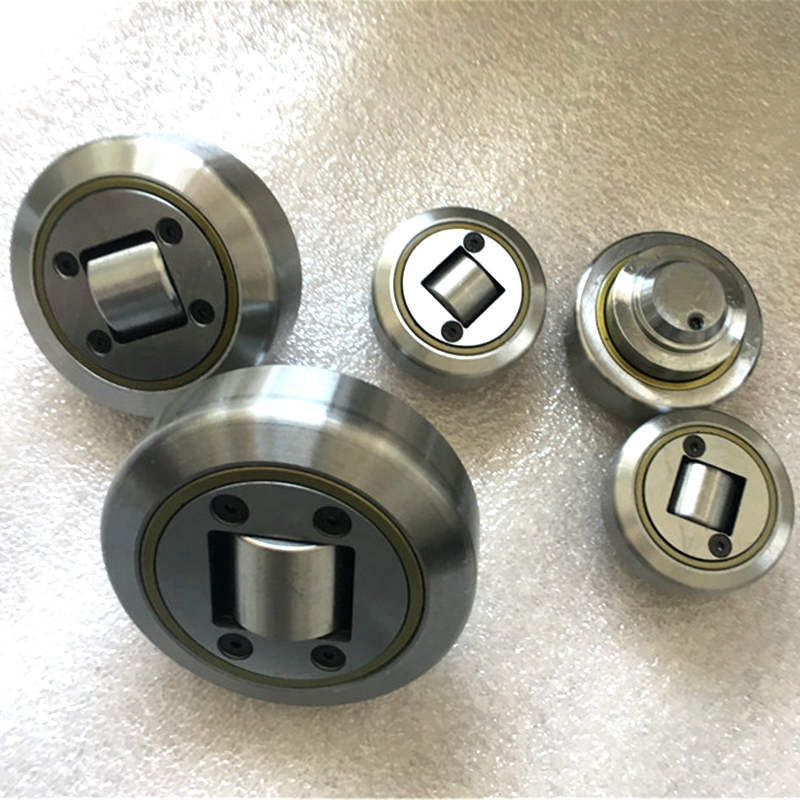
Combined Roller Bearings Introduction:
Combined roller bearings are assembled by two axial and radial roller bearings.
They were originally developed for the track of logistics equipment. Now they are mainly used in conjunction with the track.
They are often called composite roller bearings, cross roller bearings or cross composite bearings, combi bearings, combined bearing, combination bearing, high load cam followers, heavy duty roller bearings, mast guide bearings and so on.
Bearing is mainly composed of main bearing, welding installation shaft, and axially supported small bearing or iron block (nylon block). Different installation and adjustment modes can be designed for different use environments.
Bearing structure is as below,
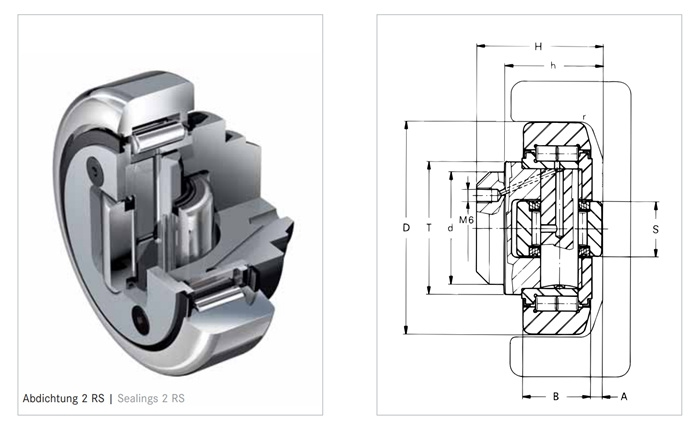
structure 1
Technical Characteristics:
Outer rings are made from case-hardened steel, UNI 16 CrNi 4 hardened at 62+2HRC.
Inner rings are made from bearing steel, En 31-SAE 52100 hardened at 62-2 HRC.
Cylindrical rollers have flat ground heads, made from En 31-SAE 52100 steel hardened at 59 ÷ 64 HRC.
Welding bolts are made from UNI FE 510.C.
Bolt tolerance: –0.05 mm.
Bearings from 4.055 to 4.063 are relubricateable.
Bearings are lubricated with grease grade 3 (for example, Shell Alvania 3, Esso Beacon 3).
Combined Roller Bearings Applications:
Bearings typical applications include but are not limited to:
– Material handling loaders and unloading machines
– Palletizers
– Cranes and hoists
– Horizontal and vertical feed and lift units
– Froklift trucks
– ASRS Systems
– Shrink-wrappers
Advantages:
1. Special design which reduceproduction costs.
2. Bearings can bear high radial and axial loads.
3. The sturdy guide rail is suitable for high dynamic and static loads. Thus bearing capacity can be well distributed on the guide rail.
As a result, both bearings and guide rails have a long service life.
4. Bearings can be assembled by welding bolts, which is economical and practical.
5. Bearing parts are easy to replace.
Common Combined Roller Bearing Size Chart:
| Model Number | D | H | h | d | T | B | S |
| 4.053 | 52.5 | 33 | 27 | 30 | 40 | 17 | 15 |
| 4.054 | 62 | 37.5 | 30.5 | 30 | 42 | 20 | 20 |
| 4.054 | 62.5 | 37.5 | 30.5 | 30 | 42 | 20 | 20 |
| 4.055 | 70.1 | 44 | 36 | 35 | 48 | 23 | 22 |
| 4.056 | 77.7 | 48 | 36.5 | 40 | 54 | 23 | 24 |
| 4.057 | 77.7 | 40.7 | 29 | 40 | 54 | 23 | 24 |
| 4.058 | 88.4 | 57 | 44 | 45 | 59 | 30 | 18 |
| 4.059 | 101.2 | 46 | 33 | 50 | 67 | 28 | 30 |
| 4.06 | 107.7 | 53 | 39 | 55 | 7 | 31 | 34 |
| 4.061 | 107.7 | 69 | 55 | 60 | 71 | 31 | 34 |
| 4.062 | 123 | 72.3 | 56 | 60 | 80 | 37 | 40 |
| 4.063 | 149 | 78.5 | 58.5 | 60 | 108 | 45 | 50 |
| 4.064 | 149 | 86 | 67 | 60 | 108 | 45 | 50 |
| 4.037 | 174 | 95 | 71 | 80 | 120 | 55 | 62 |
| 4.039 | 185 | 95 | 71 | 80 | 120 | 55 | 62 |
Product model path
Special roller bearing options for replacement checks
These special bearing options support cam follower, needle roller, eccentric roller, axial roller, and combined bearing replacement checks.
11309 Bearing 1310K+H310 Self Aligning Ball Bearing 45*110*27
11309 Bearing helps buyers check special bearing structures such as cam follower, needle roller, eccentric roller, axial roller, or combined bearing options.
4.062 Winkel Combined Bearing MR0029, 400-0062 Axial Bearing
4.062 Winkel Combined Bearing helps buyers check special bearing structures such as cam follower, needle roller, eccentric roller, axial roller, or combined bearing options.
4.461 Axial Single Row Roller Bearing Adjustable 60*107.7*69mm
4.461 Axial Single Row Roller Bearing helps buyers check special bearing structures such as cam follower, needle roller, eccentric roller, axial roller, or combined bearing options.
611GSS+35-43 Eccentric Roller Bearing 611GSS With Eccentric Sleeve 35-43
611GSS+35-43 Eccentric Roller Bearing helps buyers check special bearing structures such as cam follower, needle roller, eccentric roller, axial roller, or combined bearing options.
6120608 YRX Eccentric Roller Bearing 6120608YRX 22×58×32mm
6120608 YRX Eccentric Roller Bearing helps buyers check special bearing structures such as cam follower, needle roller, eccentric roller, axial roller, or combined bearing options.
614 13-17 YSX Eccentric Roller Bearing 25UZ851317 Size 25×68.5×42mm
614 13-17 YSX Eccentric Roller Bearing helps buyers check special bearing structures such as cam follower, needle roller, eccentric roller, axial roller, or combined bearing options.
CF12B Bearing KR30XSK Cam Follower Bearing 16*40*23
CF12B Bearing helps buyers check special bearing structures such as cam follower, needle roller, eccentric roller, axial roller, or combined bearing options.
NA69/22 Bearing NA69/22R Needle Roller Bearing NA69/22-XL
NA69/22 Bearing helps buyers check special bearing structures such as cam follower, needle roller, eccentric roller, axial roller, or combined bearing options.
NART40R Bearing NATR40 Support Roller Bearing MCYRR40
NART40R Bearing helps buyers check special bearing structures such as cam follower, needle roller, eccentric roller, axial roller, or combined bearing options.
NKXR17Z Bearing NKXR17-Z-A Sealed Needle Roller Bearing 17*26*25
NKXR17Z Bearing helps buyers check special bearing structures such as cam follower, needle roller, eccentric roller, axial roller, or combined bearing options.
RAX712 Bearing RAX 712 Y Needle Roller Bearing 12x18x14.2
RAX712 Bearing helps buyers check special bearing structures such as cam follower, needle roller, eccentric roller, axial roller, or combined bearing options.
Questions that help before the next bearing decision after Combined Roller Bearings
Which next options usually help after reviewing Combined Roller Bearings?
Most buyers benefit from one broader family destination, one more commercial route, and one supporting guide that answers the next practical question. That combination usually turns research into a clearer shortlist.
Why add related bearing destinations beside Combined Roller Bearings?
Because the first answer often leads to a second question about fit, applications, supplier choice, or repeat-order confidence. Keeping those next destinations close reduces unnecessary backtracking.
When is it worth moving from reading into a quote or product review?
That move usually makes sense once the topic has narrowed the likely bearing family and the remaining unknowns are commercial, dimensional, or application-specific rather than purely educational.
What usually makes the next bearing decision easier after Combined Roller Bearings?
The process is often easier when the wider family view, the more commercial destination, and one practical guide stay visible together. That keeps the decision grounded in both application detail and buying reality.
Buyer FAQ
Questions buyers ask before choosing the next bearing option
What is the main takeaway from Combined Roller Bearings?
The main takeaway is that combined roller bearings should be checked against the bearing family, dimensions, load direction, speed, and operating conditions instead of relying on the title or size alone.
When should I use this guide before requesting a quote?
Use the guide when you are comparing bearing models, checking suffix meanings, confirming seal or clearance choices, planning maintenance, or preparing details for replacement, production, or OEM sourcing.
How does this topic connect to special / other bearings?
The topic supports the Special / Other Bearings decision path by helping buyers understand fit, performance, specification details, or maintenance factors before choosing a product page or contacting the team.
Can this guide replace a final specification check?
No. The guide helps prepare the decision, but a final check should still confirm the part number, dimensions, load, speed, seal, clearance, precision, application, and order quantity.
What should I send if I need help after reading this guide?
Send the bearing number, measured size, photos if available, application, quantity, and any special operating conditions. That gives the team enough context to recommend the right product family or quote route.
Need help checking fit, price, or lead time? Request a bearing quote